
Pre-Shipment Inspection,
Testing & Certificate
of Conformity for Egypt
Program of Goods Exported to the Arab Republic of Egypt. Comprehensive inspection, testing, and certification solutions ensuring your exports comply with Egyptian import regulations, appointed by GOEIC.
Pre-Shipment Inspection
On-site quality assessmentTesting
Comprehensive product testingCertification
CoC issuance for EgyptDriving Excellence, Ensuring Compliance
TICQC is a quality control service company committed to delivering expert consulting and tailored quality solutions in highly competitive environments.
We strategically adapt to evolving market trends, continuously enhancing our performance to implement best practices across projects of all sizes.
General Organization for Export & Import Control (GOEIC)
TICQC has been appointed by GOEIC to implement Pre-Shipment Inspection, testing, and issuance of Certificates of Conformity (CoC) for goods exported to the Arab Republic of Egypt.
Verification of Conformity Program
TIC has been appointed by GOEIC to implement Pre-Shipment Inspection, testing, and issuance of Certificates of Conformity (CoC) for goods exported to the Arab Republic of Egypt.
Program Goals
The Egypt VoC program safeguards consumers and ensures only quality goods enter the market.
- Protect industries from unfair competition
- Prevent non-compliant products flooding the local market
- Simplify customs clearance
- Minimize risk of product rejection at destination
- Consumer safety
Type of Products
A wide range of product categories fall under Egypt CoC requirements.
- Cosmetics & Personal Care
- Electrical Household Appliances
- Iron & Steel / Construction Materials
- Textiles, Clothing & PPE
- Tiles, Ceramics & Granite
- And many more below
COC Process
The certification process follows strict international quality assurance protocols.
- Request for certification
- Documentary Review / Testing
- Inspection (PSI)
- Certificate
- Egypt Border Inspection
Full List of Covered Products
All goods in the categories below require a valid Certificate of Conformity before import clearance into Egypt.
Registration Process
Follow the streamlined registration and certification workflows for goods destined for the Egyptian market.
Application for Registration
Request for Registration (RFR)
Verification
- Testing
- Inspection
- Documents Review
Statement of Registration (SOR)
Registered Goods Workflow
Registered Goods
SoR Verification & Monitoring
CoC
Egypt Border Inspection
Basic Process Workflow — Unregistered Goods
Request for Certification
Documentary Review / Testing
Inspection (PSI)
Certificate of Conformity (COC)
Egypt Border Inspection
Certificate
Non-Conformity (NCR)
Download Forms & Documents
Access and download all necessary documentation for the Egypt CoC Program registration and certification process.
Regulated Products
GOEIC product scope
The complete list of product categories regulated under the Egypt CoC program that require a valid Certificate of Conformity before import clearance.
Download FormRFC GOEIC Form
TIC-IMS-EGY-FRM-25-01
Official Request for Certification form for goods exported to Egypt under the GOEIC program. Complete and submit this form to initiate your CoC process.
Download FormTIC Company Profile
About TIC Quality Control
Download our full company profile detailing TIC Quality Control's services, accreditations, global reach, and expertise in CoC certification.
Download ProfileCOC Format
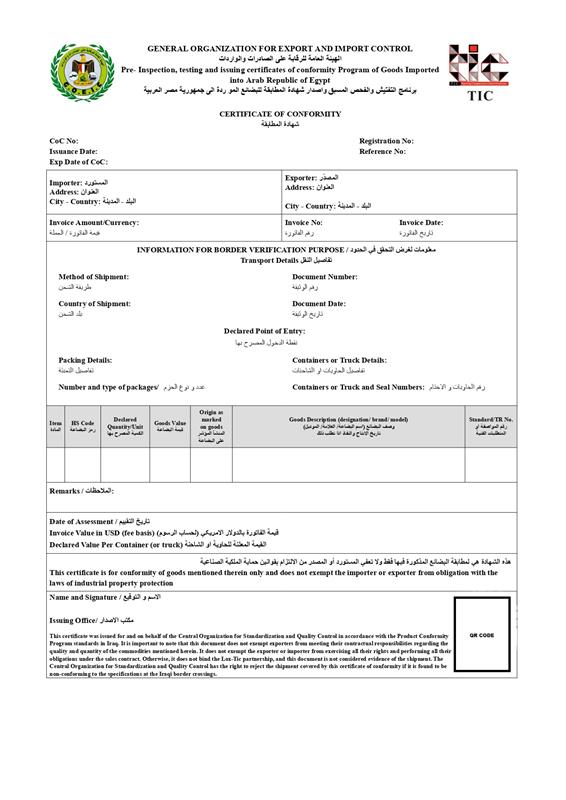
Certificate of Conformity template
The official Certificate of Conformity format issued by TIC Quality Control under the GOEIC appointed program for goods exported to Egypt.
Download LetterReady to Export to Egyptian
Markets?
Partner with TIC Quality Control, appointed by GOEIC, trusted by exporters and manufacturers across 15+ countries worldwide.
Egypt Certificate of Conformity (CoC) — Complete Guide for Exporters
Exporting goods to Egypt requires strict adherence to the country's import compliance framework. At the heart of this framework is the Egypt Certificate of Conformity (CoC), a mandatory document issued by GOEIC-appointed inspection bodies such as TIC Quality Control (TICQC). Whether you are a manufacturer, trader, or freight forwarder, understanding the Egypt CoC program is essential for smooth customs clearance, avoiding costly delays, and maintaining your access to the Egyptian market.
This comprehensive guide covers everything exporters need to know about the Egypt CoC program, from the regulatory background and product scope to step-by-step certification workflows, required documentation, testing standards, and frequently asked questions.
What Is the Egypt CoC?
The Egypt Certificate of Conformity (CoC) is an official document that certifies a product meets the applicable Egyptian standards and technical regulations before it is allowed to enter the country. The CoC is issued after a Pre-Shipment Inspection (PSI), documentary review, and/or laboratory testing of the goods at the country of origin — before the shipment leaves the exporter's facility.
Without a valid CoC, goods may be held at Egyptian ports, subjected to additional inspections by customs authorities, or refused entry entirely. The CoC is therefore not merely a bureaucratic formality — it is the primary gateway document for market access into Egypt.
The Egypt CoC program is implemented by the General Organization for Export and Import Control (GOEIC), the official Egyptian government body responsible for regulating and overseeing the quality and safety of imported goods.
Why Was the Egypt CoC Program Introduced?
Egypt introduced the mandatory Verification of Conformity (VoC) / CoC program to address several key challenges in its import trade environment:
- Prevent the influx of substandard, counterfeit, and non-compliant goods into the local market
- Protect Egyptian consumers from safety hazards posed by low-quality imported products
- Safeguard domestic industries from unfair competition from cheap, non-compliant imports
- Align Egypt's import control framework with international quality assurance best practices
- Facilitate faster and more predictable customs clearance for compliant exporters
- Reduce the burden on Egyptian border inspection authorities by shifting quality checks to the country of export
The program has been progressively expanded over the years to cover an increasingly wide range of product categories, reflecting Egypt's commitment to raising quality standards across its import ecosystem.
GOEIC — The Regulatory Authority Behind Egypt CoC
The General Organization for Export and Import Control (GOEIC) is an Egyptian government body operating under the Ministry of Trade and Industry. GOEIC is the official authority responsible for:
- Setting and updating the list of regulated product categories requiring a CoC
- Appointing international inspection and certification bodies authorized to issue CoCs
- Overseeing the quality assurance of goods imported into and exported from Egypt
- Enforcing compliance at Egyptian ports and border crossings
- Coordinating with international standards bodies to align Egypt's requirements with global benchmarks
GOEIC appoints a select group of international conformity assessment bodies to carry out the inspection, testing, and CoC issuance on its behalf. TIC Quality Control (TICQC) is one such appointed body, authorized to conduct Pre-Shipment Inspections and issue Certificates of Conformity for goods destined for Egypt from any country of origin worldwide.
GOEIC-Appointed Inspection Bodies
Not all inspection companies are authorized to issue valid Egypt CoCs. Only bodies that have been formally appointed by GOEIC and meet its strict accreditation requirements are recognized. Using a non-appointed body will result in a CoC that is rejected at Egyptian customs, leading to shipment holds and potential penalties.
TICQC's appointment by GOEIC ensures that every certificate we issue is fully recognized and accepted by Egyptian customs authorities, giving exporters complete confidence in their shipment clearance process.
Which Products Require an Egypt Certificate of Conformity?
The Egypt CoC requirement applies to a broad and growing list of product categories. Below is a detailed overview of the major regulated sectors:
1. Cosmetics, Personal Care & Hygiene Products
Egypt applies strict quality and safety standards to all cosmetics and personal care products imported into the country. This category includes skincare products (creams, lotions, serums), hair care products (shampoos, conditioners, dyes), makeup and colour cosmetics, deodorants and antiperspirants, nail care products, and baby care cosmetics. All products in this category must demonstrate compliance with Egyptian chemical safety standards, labelling requirements, and ingredient restrictions.
2. Electrical & Electronic Household Appliances
Electrical appliances represent one of the largest regulated categories under the Egypt CoC program. Products include washing machines, refrigerators, air conditioners, microwave ovens, electric cookers, dishwashers, vacuum cleaners, electric fans, water heaters, and many other household devices. These products are assessed for electrical safety, electromagnetic compatibility (EMC), and energy efficiency in accordance with applicable Egyptian standards (ES) and equivalent international standards.
3. Lighting Devices & Cables
LED lamps, energy-saving compact fluorescent lamps (CFLs), fluorescent tubes, luminaires, insulated wires, and low-voltage electrical cables all require a valid Egypt CoC. These products are tested for electrical safety, insulation quality, fire resistance, and compliance with Egyptian electrical standards.
4. Iron, Steel & Construction Materials
Egypt is a major importer of construction materials, and this sector is tightly regulated to ensure structural safety and quality. Regulated products include steel bars and rods for reinforcement, structural steel sections, iron pipes and fittings, welding wires, and related construction materials. Products are tested to verify mechanical properties, chemical composition, dimensional tolerances, and compliance with Egyptian building standards.
5. Textiles, Clothing & Apparel
All imported textiles and clothing must comply with Egyptian labelling regulations, fibre composition requirements, and safety standards. This includes ready-to-wear garments for men, women, and children, home textiles (bed linen, towels, curtains), technical textiles, and fabrics. Testing typically covers fibre content analysis, colourfastness, dimensional stability, and chemical safety (restricted substances).
6. Personal Protective Equipment (PPE)
Given Egypt's growing industrial sector, PPE imports are subject to rigorous certification requirements. This includes safety helmets, high-visibility clothing, protective gloves, safety footwear, respiratory protective devices, eye and face protection, and fall protection equipment. Products must meet the relevant EN or ISO standards that Egypt has adopted.
7. Children's Toys
Toy safety is a top priority under the Egypt CoC program. All imported toys must be tested for mechanical and physical safety (sharp edges, small parts, tension), chemical safety (restricted substances such as heavy metals, phthalates, and formaldehyde), flammability, electrical safety (for electronic toys), and age-appropriate labelling. Compliance with EN 71 or equivalent standards is typically required.
8. Footwear & Leather Goods
Footwear — including casual shoes, sports shoes, safety shoes, and sandals — as well as leather bags, belts, and accessories require a CoC for import into Egypt. Testing covers material composition, restricted chemical substances, labelling compliance, and physical performance criteria.
9. Paper Products
Disposable paper products including diapers and nappies, feminine hygiene / sanitary pads, toilet paper and tissue, and wet wipes are regulated under the Egypt CoC program. These products are assessed for hygiene safety, chemical composition, and compliance with Egyptian consumer product standards.
10. Tiles, Ceramics, Marble & Granite
Floor and wall tiles, ceramic products, marble slabs, and granite tiles require certification. Testing covers dimensional tolerances, water absorption, breaking strength, surface quality, chemical resistance, and slip resistance properties in accordance with ISO 13006 and equivalent Egyptian standards.
11. Sanitary Ware & Plumbing
Bathroom and kitchen products including sinks, washbasins, toilet seats, shower cabins and trays, faucets, mixers, and plumbing fittings are covered. These products must meet Egyptian standards for dimensional accuracy, material quality, water efficiency, and chemical safety.
12. Furniture
Home and office furniture including sofas, beds, wardrobes, office chairs, desks, and storage units require a CoC. Relevant standards cover structural stability, material safety (formaldehyde emissions from wood-based panels, restricted flame retardants), surface durability, and labelling.
13. Bicycles, Scooters & Motor Vehicles
Personal mobility products including bicycles, electric bikes (e-bikes), kick scooters, electric scooters, motorbikes, and motor vehicles are regulated. These products require assessment of safety features, braking performance, lighting, reflectors, mechanical strength, and compliance with applicable road safety standards.
14. Batteries
Primary (dry) batteries, sealed lead-acid batteries, and traction batteries (golf cart batteries) all fall under the Egypt CoC scope. Testing covers electrochemical performance, safety under short-circuit and overcharge conditions, labelling, and chemical composition.
15. Additional Regulated Product Categories
Beyond the major categories detailed above, the Egypt CoC program also covers kitchen utensils and tableware, perfume and fragrance products, oral and dental health products, soaps, disinfectants and cleaning products, food contact materials and packaging, kitchen appliances (pressure cookers, blenders, kettles), air fresheners, glassware, locks and security fittings, LPG valves and low-pressure regulators, carpets and floor coverings, artificial grass, wristwatches and clocks, pallets, and shaving and hair care devices.
The Egypt CoC Certification Process — Step by Step
Understanding the CoC process is critical for planning your export timelines and avoiding costly delays. The process differs slightly depending on whether your products are already registered under the GOEIC system or are being certified for the first time as unregistered goods.
Process for Unregistered Goods (First-Time Certification)
Step 1 — Request for Certification (RFC)
The exporter or their authorized representative submits a formal Request for Certification (RFC) to TICQC. The RFC form (TIC-IMS-EGY-FRM-25-01) must be completed with full details of the shipment including product description, HS codes, manufacturer details, country of origin, exporter and importer information, and the relevant Egyptian standard(s) to be assessed against.
Step 2 — Documentary Review
TICQC's technical team reviews the submitted documentation to verify the product's conformity on paper before any physical inspection. Required documents typically include the commercial invoice, packing list, product technical data sheets or specifications, existing test reports (if any), manufacturing quality certifications (ISO 9001, etc.), product labels and markings, and any previous CoCs for the same product.
Step 3 — Laboratory Testing
If valid third-party test reports are not available, or if the documentary review identifies gaps, representative product samples are sent to an accredited laboratory for testing against the applicable Egyptian standard(s). TICQC works with an extensive network of ISO/IEC 17025-accredited laboratories globally to ensure fast and reliable testing turnaround.
Step 4 — Pre-Shipment Inspection (PSI)
A Pre-Shipment Inspection (PSI) is conducted at the exporter's facility or warehouse, typically once the goods are packed and ready for shipment. The PSI involves visual and physical examination of the goods, verification of quantities and packing against the shipping documents, checking of product markings and labels, and sampling for testing (if required). The PSI is a critical step — it provides the physical evidence that the goods actually conform to the specifications declared in the documents.
Step 5 — Certificate of Conformity Issuance
Upon successful completion of documentary review, testing (where applicable), and PSI, TICQC issues the official Certificate of Conformity (CoC) for the shipment. The CoC is transmitted electronically to GOEIC's system and provided to the exporter for inclusion in the shipping documents.
Step 6 — Egypt Border Inspection
Upon arrival in Egypt, the shipment is subject to border inspection by GOEIC at the port of entry. Customs clearance is conditional on presentation of a valid CoC. In many cases, a valid CoC from an appointed body like TICQC significantly expedites the border inspection process, as the pre-shipment verification provides assurance to GOEIC inspectors.
Non-Conformity (NCR)
If the documentary review, testing, or PSI reveals non-conformity issues, TICQC issues a Non-Conformity Report (NCR). The exporter is then required to undertake corrective actions (rework, product replacement, re-testing) before a CoC can be issued. TICQC's technical team works closely with exporters to guide them through the corrective action process efficiently.
Registration Process — Statement of Registration (SoR)
For exporters who regularly ship the same products to Egypt, GOEIC offers a Registration pathway that simplifies the ongoing CoC process. Once a product is registered, subsequent shipments benefit from a streamlined verification and monitoring process.
Step 1 — Request for Registration (RFR)
The manufacturer or exporter submits a Request for Registration (RFR) through TICQC. This involves providing comprehensive product and manufacturing facility documentation for GOEIC's review.
Step 2 — Verification
TICQC conducts a thorough verification process that may include factory inspection (assessment of the manufacturer's quality management systems and production processes), product testing against Egyptian standards, and full documentary review.
Step 3 — Statement of Registration (SoR)
Upon successful verification, GOEIC issues a Statement of Registration (SoR) for the product. The SoR is valid for a defined period and confirms that the product and its manufacturing process have been assessed and found compliant.
Registered Goods Workflow
Once a product holds a valid SoR, subsequent shipments follow a simplified workflow: TICQC conducts ongoing SoR verification and monitoring (which may include periodic factory audits, surveillance testing, and shipment verification), and issues a CoC for each conforming shipment. This registered goods workflow is significantly faster than the full first-time certification process, making it ideal for high-volume regular exporters.
Required Documents for Egypt CoC Application
Preparing your documentation correctly from the outset is the single most effective way to accelerate your CoC process. The following table summarizes the key documents typically required:
| Document | Purpose | Required For |
|---|---|---|
| Completed RFC Form (TIC-IMS-EGY-FRM-25-01) | Initiates the certification process | All shipments |
| Commercial Invoice | Confirms shipment value and details | All shipments |
| Packing List | Details quantities, weights, dimensions | All shipments |
| Product Technical Data Sheet / Specifications | Defines product composition and characteristics | All shipments |
| Existing Test Reports (ISO/IEC 17025 accredited) | Evidence of product compliance with standards | Where available |
| Product Labels / Artwork | Verification of labelling compliance | All regulated products |
| Bill of Lading / AWB | Shipment identification | Post-loading CoCs |
| ISO 9001 or equivalent quality certificate | Evidence of manufacturer's quality systems | Registration process |
| MSDS / Safety Data Sheet | Chemical product safety information | Chemical / cosmetic products |
TICQC's dedicated customer support team will guide you through the exact documentation requirements specific to your product category and shipment type, ensuring your application is complete from day one.
Egyptian Standards — What Your Products Are Tested Against
Egyptian standards are developed and published by the Egyptian Organization for Standardization and Quality (EOS). Egyptian Standards (ES) are largely harmonized with international standards, particularly ISO, IEC, and EN standards published by the European Committee for Standardization (CEN) and European Committee for Electrotechnical Standardization (CENELEC).
For products where no specific Egyptian standard exists, GOEIC may accept internationally recognized standards such as ISO, IEC, EN, ASTM, or JIS as the applicable conformity benchmark. TICQC's technical experts have deep familiarity with the applicable standards across all regulated product categories and will advise you on the exact requirements for your specific goods.
Key Standards Frameworks by Product Category
- Electrical appliances: IEC 60335 series (household appliances), IEC 60065 (audio/video equipment), Egyptian equivalent ES standards
- Toys: EN 71 series (European Toy Safety Standard), ISO 8124 series
- PPE: EN 340, EN 388, EN 397, EN ISO 20345 series
- Cosmetics: EOS cosmetics standards, GCC cosmetics regulations (for formulation safety)
- Textiles: OEKO-TEX / REACH compliance for restricted substances, ES labelling requirements
- Construction materials: ES 262 (steel bars), ISO 6935, relevant structural standards
- Tiles: ISO 13006, ES equivalent standards
- Cables and wires: IEC 60227, IEC 60245 series
Common Reasons for CoC Rejection — and How to Avoid Them
Drawing on TICQC's extensive experience implementing the Egypt CoC program, the following are the most common reasons exporters encounter non-conformity issues or certification delays:
1. Incomplete or Inaccurate Documentation
Missing documents, inconsistencies between the commercial invoice and packing list, incorrect HS codes, or incomplete product descriptions are among the most frequent causes of certification delays. Solution: Engage with TICQC early in the export planning process to ensure your documentation package is complete and accurate before the inspection is scheduled.
2. Non-Compliant Product Labelling
Egypt has specific labelling requirements for most regulated product categories, including requirements for Arabic language labelling, country of origin marking, safety warnings, and content/composition declarations. Non-compliant labels are a very common reason for NCR issuance. Solution: Review Egypt's labelling requirements for your product category with TICQC before production or at least before final packaging.
3. Products Not Meeting Egyptian Standards
Products that perform acceptably in other markets may not meet the specific Egyptian standard requirements — particularly where Egypt has adopted more stringent limits than other countries for certain parameters (e.g., chemical restrictions in cosmetics or textiles, mechanical performance of construction materials). Solution: Obtain a pre-assessment from TICQC's technical team to identify any potential compliance gaps before you commit to producing or shipping the goods.
4. Outdated or Non-Accredited Test Reports
Test reports that are outdated, issued by non-accredited laboratories, or that do not cover the full scope of the applicable standard will not be accepted for the documentary review. Solution: Ensure all test reports submitted are from ISO/IEC 17025-accredited laboratories, cover the current version of the applicable standard, and are within the accepted validity period (typically 3 years).
5. Goods Not Matching Approved Samples or Specifications
If the goods inspected during the PSI differ materially from the specifications or samples previously assessed during testing, a non-conformity will be raised. This can happen due to production changes, substitution of materials, or manufacturing variations. Solution: Maintain tight production controls and notify TICQC promptly of any changes to product specifications or manufacturing processes.
Benefits of Working with TICQC for Your Egypt CoC
Choosing the right GOEIC-appointed certification partner makes a significant difference to your export experience. Here is why exporters across the globe trust TICQC for their Egypt CoC requirements:
GOEIC Official Appointment
TICQC is formally appointed by GOEIC, the sole regulatory authority for Egypt's import control program. Every CoC we issue is directly recognized and accepted by Egyptian customs authorities without question.
Global Inspection Coverage
With a presence in 15+ countries and a network of 500+ qualified engineers, inspectors, and technical experts, TICQC can conduct Pre-Shipment Inspections at your facility anywhere in the world — from manufacturing hubs in China, India, Turkey, and Southeast Asia to production facilities in Europe, the Middle East, and Africa.
Accredited Laboratory Network
TICQC works with an extensive global network of ISO/IEC 17025-accredited laboratories, enabling fast and reliable testing for all regulated product categories. Our laboratory partnerships allow us to offer competitive testing turnaround times without compromising on accuracy or accreditation status.
Technical Expertise Across All Product Categories
Our team includes specialists with deep domain expertise in each regulated product category, from electrical safety engineers and chemists to textile technologists and construction materials specialists. This means you get technically sound, category-specific guidance — not generic advice.
Fast Turnaround
We understand that export deadlines are non-negotiable. TICQC is committed to fast application processing, prompt inspection scheduling, and efficient CoC issuance to keep your shipments moving on schedule.
End-to-End Service
From initial consultation and documentation review through testing, Pre-Shipment Inspection, and CoC issuance, TICQC provides a fully integrated, end-to-end service. You have a single point of contact for your entire Egypt CoC process — simplifying communication, reducing administrative burden, and ensuring nothing falls through the cracks.
24/7 Client Support
Our customer support team is available around the clock to answer queries, provide status updates, and resolve any issues that arise during the certification process — no matter where in the world you are located or what time zone you are in.
Egypt CoC — Frequently Asked Questions
Is a CoC mandatory for all goods exported to Egypt?
No — the Egypt CoC requirement applies specifically to the product categories listed under the GOEIC regulated products list. Goods that do not fall within any regulated category are not subject to the pre-shipment CoC requirement. However, the regulated products list is periodically updated, so exporters should verify the current scope with TICQC before assuming their products are exempt.
How long does the Egypt CoC process take?
The timeline varies depending on the product category, the completeness of documentation, and whether laboratory testing is required. For well-documented shipments of products with existing valid test reports, the CoC process can be completed in as few as 3–5 working days. Where new laboratory testing is required, the overall timeline may extend to 2–6 weeks depending on the test parameters and laboratory availability. TICQC will provide a realistic timeline estimate at the outset of your application.
Can the CoC be obtained after the goods have been shipped?
The Egypt CoC program is fundamentally a Pre-Shipment Inspection program — the CoC is intended to be obtained before the goods leave the country of origin. In exceptional circumstances and with GOEIC's authorization, post-shipment certification may be possible, but this is not the standard process and may result in complications at Egyptian customs. TICQC strongly recommends initiating the CoC process well in advance of your planned shipment date.
Does the CoC need to be in Arabic?
The CoC issued by TICQC as a GOEIC-appointed body is produced in a standardized format that is accepted by Egyptian customs. Certain accompanying documents (such as product labels) may require Arabic language content. TICQC will advise on the specific language requirements for your product category and shipment documents.
How long is a CoC valid?
A CoC is typically issued for a specific shipment and is valid for the customs clearance of that shipment. It is not a product approval that covers all future shipments — each new shipment requires its own CoC. However, registered goods under a valid Statement of Registration (SoR) benefit from a simplified and faster CoC issuance process for subsequent shipments.
What happens if my goods fail the inspection or testing?
If your goods are found non-conforming during the PSI or testing, TICQC will issue a Non-Conformity Report (NCR) detailing the specific non-conformances identified. You will have the opportunity to undertake corrective actions (rework, replacement, re-testing) and request a follow-up inspection. TICQC's technical team will support you through the corrective action process. No CoC will be issued until conformity has been demonstrated.
Do I need a CoC if I already have an ISO 9001 certificate?
ISO 9001 certification demonstrates that your quality management system meets the ISO 9001 standard, but it does not replace the product-specific CoC requirement for Egypt. The Egypt CoC certifies that specific products in a specific shipment meet the applicable Egyptian product standards — this is a product conformity assessment, distinct from a management system certification. Both may be relevant, and ISO 9001 certification may support the registration process, but it does not exempt you from the CoC requirement.
Can TICQC help with both the CoC and the product registration (SoR)?
Yes — TICQC provides comprehensive support for both the shipment-level CoC process and the product registration process leading to a Statement of Registration (SoR). Our team can advise you on whether registration is appropriate for your products and export volumes, and guide you through the full registration process from initial application through verification and SoR issuance.
Start Your Egypt CoC Journey with TICQC
Whether you are exporting to Egypt for the first time or looking to streamline an existing certification process, TICQC is your trusted, GOEIC-appointed partner. Our combination of regulatory expertise, global inspection reach, accredited testing capabilities, and dedicated client support makes us the preferred choice for exporters across more than 15 countries worldwide.
Don't let CoC compliance be a barrier to your Egyptian market access. Contact TICQC today to discuss your specific products, shipment timelines, and certification requirements. Our experts will design a tailored Egypt CoC solution that keeps your goods moving and your customers in Egypt satisfied.
Ready to get started? Download the RFC form (TIC-IMS-EGY-FRM-25-01) from our resources section, complete it with your shipment details, and send it to our team. We will respond within one business day with a detailed quote and timeline for your Egypt CoC application.