If you are involved in manufacturing, importing, or exporting goods, you have almost certainly come across the term Certificate of Conformity, or CoC. It appears on customs checklists, supplier contracts, and regulatory documents. Yet many businesses still do not fully understand what it is, why it is required, or what happens if they do not have one.
This guide answers all of those questions in plain, practical language. Whether you are new to compliance or looking to sharpen your knowledge before entering markets like Iraq, Egypt, or Libya, this article covers everything you need to know about the Certificate of Conformity.
Certificate of Conformity: The Basic Definition
A Certificate of Conformity (CoC) is an official document that confirms a product, process, or service meets a defined set of standards or regulatory requirements. It is typically issued by an accredited third-party inspection or certification body after the product has been assessed through testing, inspection, or audit.
Think of it as a formal written guarantee that says: this product has been checked and it meets the required standards. The certificate references specific regulations or technical specifications, and it identifies the body responsible for making that determination.
The standards referenced in a CoC can be international, such as ISO standards; regional, such as Arab technical regulations; or country-specific regulations set by national standards bodies in the destination market.
Why is a Certificate of Conformity Important?
A CoC is not just paperwork. It has real commercial and legal significance. Here is why it matters:
• Protects Consumer Safety: The primary purpose of conformity standards is to keep people safe. Products that do not meet safety requirements can cause injury, illness, or environmental damage. A CoC provides documented evidence that proper testing has taken place.
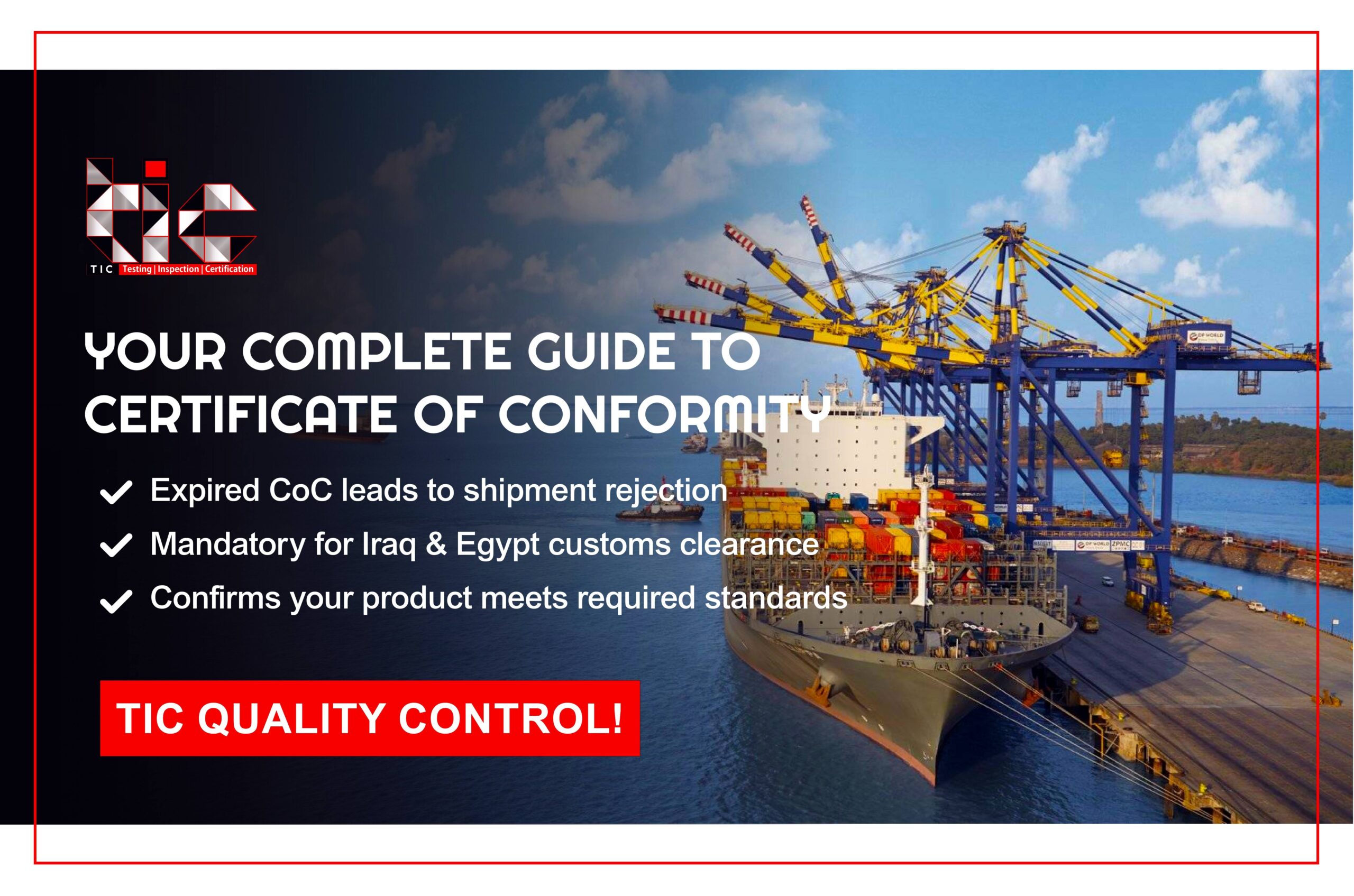
• Enables Market Access: Many countries require a valid CoC before goods can clear customs. In Iraq, Egypt, and Libya, regulated products cannot legally enter the market without certification from an approved body. Without this document, shipments can be delayed, rejected, or returned at the port.
• Demonstrates Legal Compliance: Manufacturers and importers are legally required to meet local and international standards. A CoC is proof of that compliance, which reduces exposure to fines, recalls, and legal liability.
• Speeds Up Customs Clearance: Well-documented shipments with valid CoCs clear customs faster. This reduces storage costs, prevents supply chain disruptions, and builds confidence between trading partners.
• Builds Business Credibility: Companies that obtain CoCs consistently signal a genuine commitment to quality. Over time, this strengthens relationships with buyers, distributors, and regulators.
Types of Certificates of Conformity
Not every Certificate of Conformity looks or functions the same. The type required depends on the product, the destination market, and the applicable regulatory framework. Here are the main categories:
1. Manufacturer’s Certificate of Conformity (MCoC)
This is a self-declaration issued by the manufacturer, confirming that their product meets the specified standards. It is generally quicker and less expensive to obtain since it does not involve an independent assessment. However, it carries less credibility in regulated markets because no third party has verified the claims.
2. Third-Party Certificate of Conformity
Issued by an independent, accredited testing or inspection organisation, this is the most widely recognised and trusted form of CoC in international trade. The certifying body evaluates the product against relevant standards and issues the certificate based on its own findings. Markets like Iraq, Egypt, and Libya require or strongly prefer third-party certification for regulated product categories.
3. Government or Regulatory Body Certificate
In certain cases, a government authority or national standards body directly issues a CoC following product assessment. These certificates carry formal legal authority in their respective jurisdictions and are often mandatory for specific product types.
4. Shipment-Specific Certificate of Conformity
Some importing countries require a separate CoC for every individual shipment rather than a single certificate covering a product type. This ensures that each consignment leaving the factory has been inspected before export, reducing the risk of substandard or counterfeit goods entering the market.
Which Industries Require a Certificate of Conformity?
Almost any product category can require conformity certification, but certain industries depend on it as a core part of their compliance framework:
• Electrical and Electronic Equipment: Appliances, cables, lighting products, and consumer electronics must meet electrical safety and electromagnetic compatibility (EMC) standards.
• Construction Materials: Steel, cement, pipes, and other structural materials require CoCs to confirm they meet load-bearing and fire resistance specifications.
• Automotive Parts and Vehicles: Vehicle components must comply with road safety regulations in the destination country.
• Medical Devices and Healthcare Products: These carry some of the strictest conformity requirements given the direct impact on patient safety.
• Food Contact Materials and Packaging: Containers, wrapping, and processing equipment must meet hygiene and food safety standards.
• Chemical and Hazardous Materials: Handling, labelling, and transport of chemicals require compliance documentation.
• Toys and Children’s Products: Material composition, mechanical hazards, and flammability all fall under detailed safety standards.
• Personal Protective Equipment (PPE): Safety helmets, gloves, respiratory protection, and similar items require certification before sale.
What Information Does a Certificate of Conformity Include?
The exact content varies by issuing body and applicable standard, but a complete and valid Certificate of Conformity typically contains the following:
• Full name and contact details of the manufacturer or supplier
• Name and address of the importer or buyer where applicable
• Detailed product description including model numbers, batch references, and technical specifications
• The specific standards or regulations with which the product complies
• Testing and inspection methods used during assessment
• Results and findings from the evaluation
• Date of issue and certificate validity period
• Name, accreditation number, and authorised signature of the issuing body
• A unique certificate reference number for tracking and verification purposes
Accuracy matters enormously. Any mismatch between the CoC and the actual shipment can trigger customs holds, rejection of goods, or questions about the authenticity of the documentation.
How to Obtain a Certificate of Conformity: Step by Step
The process of obtaining a CoC follows a clear sequence. While the details vary by product and destination market, the general steps are:
• Step 1: Identify the Applicable Standards: Start by determining which standards apply to your product in the target market. This involves understanding both the product category and the regulatory environment of the country you are exporting to.
• Step 2: Choose an Accredited Certification Body: Select a recognised and accredited inspection or testing organisation. Verify that they hold accreditation from a reputable national or international body and are accepted by the relevant market authorities.
• Step 3: Prepare and Submit Technical Documentation: Provide the certification body with all relevant product documentation, including design specifications, material data sheets, manufacturing process details, and any previous test reports.
• Step 4: Testing and Inspection: The product is evaluated against the applicable standards. This may involve laboratory testing, chemical analysis, performance testing, or on-site factory audits, depending on the product type and standard.
• Step 5: Review and Certificate Issuance: If your product meets all requirements, the certification body issues the Certificate of Conformity. If it does not, you will need to address any non-conformities and arrange a re-assessment before the certificate can be issued.
• Step 6: Maintain Ongoing Compliance: A CoC is not a one-time achievement. Standards are updated, products are revised, and certificates have expiry dates. Businesses must monitor these changes and renew certification as required to remain compliant.
Certificate of Conformity Requirements in Iraq, Egypt and Libya
For businesses exporting to Iraq, Egypt, and Libya, understanding the conformity certification requirements of each market is essential before goods reach the border.
Iraq
Iraq operates a mandatory Conformity Assessment Programme (CAP) that came into effect in January 2020. Under this programme, a Certificate of Conformity is required for a wide range of regulated product categories before goods can enter the Iraqi market. Covered categories include electrical and electronic appliances, food products, toys, vehicle spare parts, chemicals, cosmetics, construction materials, and textiles. Every shipment of regulated goods must be accompanied by a CoC issued by an approved certification body in the country of export. Shipments arriving without a valid CoC are rejected at Iraqi customs. Additionally, certain electrical products must carry the Iraqi Quality Mark (IQM) as an added layer of compliance.
Egypt
Egypt enforces a mandatory pre-shipment inspection programme for a broad range of imported goods. Regulated products cannot enter the Egyptian market without a Certificate of Inspection issued by an approved third-party body before the goods leave the country of origin. Product categories subject to conformity requirements in Egypt include electrical and electronic devices, textiles, footwear, leather goods, cosmetics, and food contact materials. Products must also carry Arabic labelling that includes the manufacturer’s name, product description, country of origin, and other required information. The inspection certificate is valid for one year from the date of issue.
Libya
In Libya, all goods exported under a Letter of Credit require a Certificate of Inspection issued by a recognised inspection company, as mandated by the Central Bank of Libya. The inspection must be carried out in the country of export before shipment, and the certificate must be presented to the importer for customs clearance on arrival. Where no Libya-specific standard exists, internationally recognised standards are applied. Product markings and instructions must be provided in Arabic, and certain prohibited categories are strictly not permitted entry.
Across all three markets, regulations are subject to change and enforcement is taken seriously. Businesses are strongly advised to verify current requirements before each shipment and to work with a certification body that has active, up-to-date knowledge of these markets.
Common Misconceptions About Certificates of Conformity
Several misunderstandings regularly cause problems for businesses dealing with CoC requirements. Here are the most common ones worth addressing:
• A CoC is the same as a quality certificate. Not quite. A CoC confirms that a specific product meets a specific standard. A quality certificate such as ISO 9001 covers a company’s overall quality management system. Both are valuable, but they are different instruments serving different purposes.
• Once certified, a product stays certified. Standards evolve, regulations are updated, and certificates have expiry dates. A CoC obtained several years ago may no longer reflect current requirements, which could leave your business exposed.
• A supplier’s self-declaration is always acceptable. In many regulated markets and for high-risk product categories, a manufacturer’s self-declaration does not satisfy regulatory requirements. Independent third-party certification is required.
• One CoC covers all markets. A certificate obtained for one country does not automatically satisfy the requirements of another. Iraq, Egypt, and Libya each operate their own regulatory frameworks, and separate certification may be needed for each destination.
• CoC requirements only apply to large manufacturers. Requirements are determined by product category and destination market, not by company size. Small and medium-sized businesses importing regulated goods face the same obligations as large corporations.
How Accredited Inspection Bodies Support CoC Certification
The value of a Certificate of Conformity is only as strong as the organisation that issues it. Accredited inspection and testing bodies play a critical role in global trade by providing independent, impartial product assessments that both buyers and regulators can trust.
Accreditation is the formal recognition that a certification body has demonstrated its technical competence to carry out specific assessments. National and international accreditation frameworks provide this recognition, ensuring that certified products are assessed to a consistent and verifiable standard.
When selecting a certification partner, businesses should confirm that the body holds accreditation from a recognised authority, has hands-on experience in the relevant product category, and is formally accepted by the authorities in the target market. Choosing the right partner from the outset can prevent costly delays, failed inspections, and compliance gaps.
Frequently Asked Questions About Certificates of Conformity
How long is a Certificate of Conformity valid?
Validity periods vary depending on the issuing body and the applicable standard. In Egypt, the inspection certificate is valid for one year. In Iraq, CoCs are typically issued per shipment. Always confirm the validity period with your certification body and build renewal reminders into your compliance calendar.
Is a Certificate of Conformity the same as a CE certificate?
No. CE marking is a specific conformity marking required for products sold in the European Economic Area (EEA). A CE certificate is one type of CoC. Other markets have their own conformity marks and certification schemes. Iraq, Egypt, and Libya each operate separate and independent conformity frameworks.
Can a Certificate of Conformity be rejected at customs?
Yes. Customs authorities can reject a CoC if the issuing body is not recognised in the destination market, if the certificate does not reference the correct standards, if the product description does not match the shipment, or if the certificate has expired. Working with an accredited and recognised certification body is the best way to avoid rejection.
What is the difference between a CoC and a test report?
A test report documents the results of specific laboratory tests conducted on a product. A Certificate of Conformity is the formal declaration, backed by those test results, that the product meets the required standards. The test report supports the CoC but is not a substitute for it.
Final Thoughts
A Certificate of Conformity is one of the most important documents in product compliance and international trade. It connects regulatory requirements with commercial reality, giving buyers, customs authorities, and consumers confidence that a product is safe, legal, and accurately represented.
For businesses exporting to Iraq, Egypt, and Libya, the CoC process requires careful attention. Standards differ by product type, regulations change regularly, and the consequences of non-compliance can include shipment rejection, financial penalties, and reputational damage. Getting this right from the start is always the better approach.
At TIC QC, we provide expert conformity assessment, testing, inspection, and certification services for manufacturers, importers, and exporters operating across global markets. Our team guides you through every step of the process, from identifying the right standards to issuing your Certificate of Conformity, so your products meet every requirement, every time.TIC Quality Control has established offices to serve clients across key trade hubs. Our TIC Quality Control Dubai office operates as the regional headquarters, supporting businesses across the UAE and the wider Middle East with Certificate of Conformity services, third-party inspection, testing, and trade compliance solutions. For clients in India’s major port and commodity trade corridor, our TIC Quality Control Gandhidham office provides on-ground CoC support for exporters operating through Kandla Port and the Gujarat region. Whether you are shipping from India or importing into the UAE, our teams are positioned where your supply chain needs them most.